Wildebeest Migration Tanzania

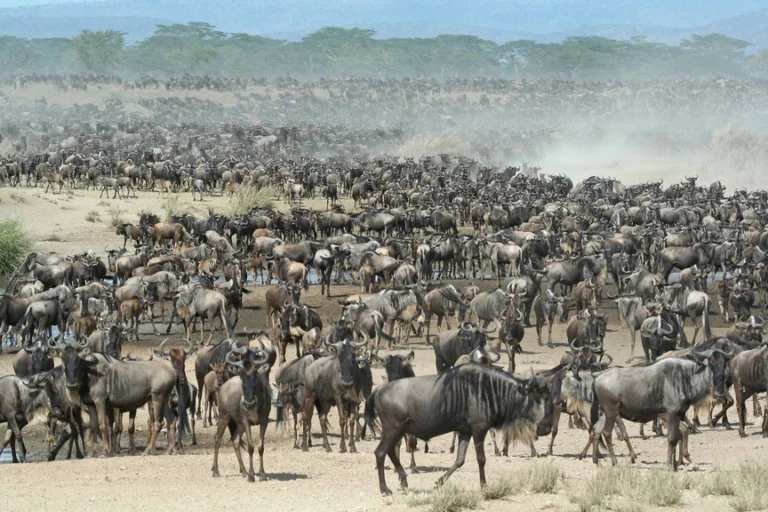
The Great Wildebeest Migration is the world’s largest terrestrial mammal migration, involving more than 1.5 million wildebeest accompanied by hundreds of thousands of zebras and gazelles. Every year, these animals travel on an approximately 800-kilometer circular journey through Tanzania’s Serengeti and Kenya’s Maasai Mara ecosystems in search of fresh grazing and water, driven by seasonal rainfall patterns.

Key Notes

  • Over 1.5 million wildebeest, together with zebras and gazelles, participate in the migration each year.
  • The migration is a continuous year-round cycle, not a single event.
  • Animal movements are determined by rainfall and grazing conditions, making exact locations and timings unpredictable.
  • The famous river crossings at the Grumeti and Mara Rivers are natural events that cannot be guaranteed and vary from year to year.
  • The Serengeti National Park offers outstanding wildlife viewing throughout the year, regardless of the migration’s location.
  • The migration provides exceptional opportunities to witness predator-prey interactions, including lions, leopards, cheetahs, hyenas, and crocodiles.
  • Every stage of the migration offers unique wildlife experiences, from calving season in the southern Serengeti to dramatic river crossings in the north.

It is a continuous circular movement, not a single event

Exact locations depend on rainfall, not fixed dates: Movement varies yearly—rainfall decides, not dates

River crossings are unpredictable

Serengeti offers excellent game viewing year-round

Serengeti Wildebeest Migration Pattern (Month by Month)

January – February | Southern Serengeti & Ndutu

Wildebeest gather on the short-grass plains (Ndutu, Kusini, Gol Kopjes)

Calving season (over 500,000 calves born)

Excellent predator action (lions, cheetahs, hyenas)

Best for photography and dramatic wildlife scenes

📍 Best areas: Ndutu, Southern Serengeti

March – April | Southern to Central Serengeti

Herds begin moving northward

Long rains start (lush landscapes, fewer crowds)

River crossings are rare but possible

📍 Best areas: Southern & Central Serengeti (Seronera)

May – June | Central & Western Serengeti

Migration moves through Seronera toward the Western Corridor

Start of Grumeti River crossings (crocodiles!)

Large columns of wildebeest on the move

📍 Best areas: Central (Seronera), Western Corridor, Grumeti

July – October | Northern Serengeti

Iconic Mara River crossings

Peak safari season

Dramatic crossings with crocodiles and big cats

📍 Best areas: Kogatende, Lamai, Mara River

📍 Note: Some herds cross into Kenya’s Maasai Mara

November – December | Return South

Short rains trigger movement back to Central and Southern Serengeti

Fresh grass draws herds south

Fewer crowds, excellent value safaris

📍 Best areas: Central Serengeti → Ndutu

All Categories
Tanzania
Travel to

Tanzania

Whats App

Talk to an expert